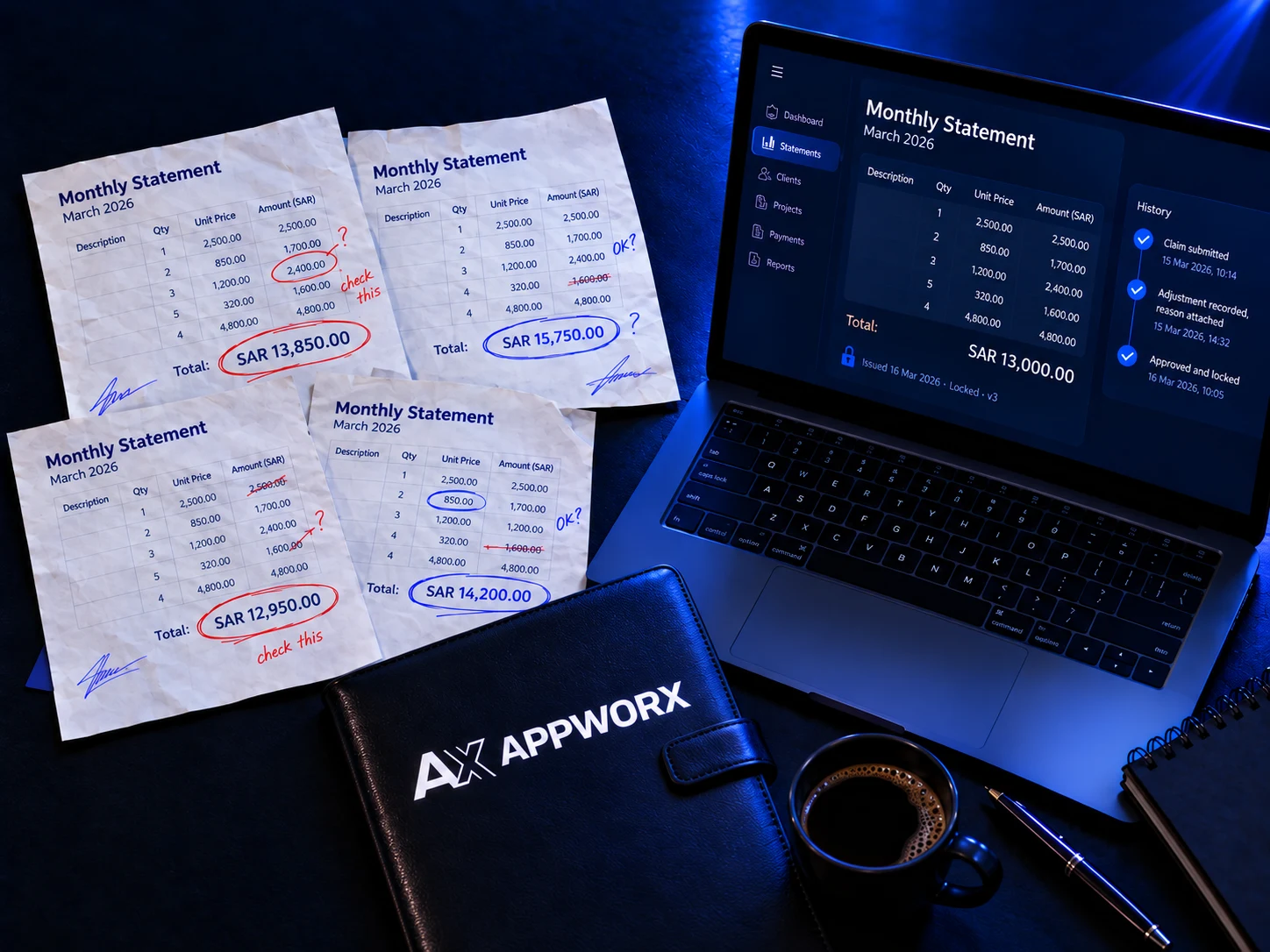
The third agency didn't walk away at the pitch. They started scoping, reached ZATCA Phase 2, and stopped.
By then the founder had already been turned down once and quoted once by a team that clearly hadn't read past the feature list. Three strikes in, he'd started believing what most Gulf founders eventually do: that agencies are unreliable by default, and a good one is luck, not method.
The client's identity and the platform's commercial name are protected under NDA. "Hissa" — Arabic for "share" — is a white-label designation used here only.
What was actually in the brief
A regulated, Sharia-compliant platform letting a retail investor put SAR 10,000–50,000 into a specific Saudi property, receive returns tied to that asset, and exit through a secondary market.
Read as a feature list, that's a listings site with a payment screen attached. Read properly, it's a regulated financial product with a digital delivery layer sitting on four compliance regimes at once:
Real estate — Wafi off-plan registry, Ejar, RERA.
Financial — CMA licensing posture, Escrow Law 2023.
Tax — ZATCA Phase 2 clearance-mode e-invoicing.
Identity — Absher, through the National Information Center's approved partner channel.
None of them optional, and none of them independent. A gap in any one isn't a UX problem. It's a platform that cannot legally operate.
The CMA question had to be settled before the first table was designed. License directly, partner with a licensed intermediary, or structure the shares so the licensing question lands differently — three different paths, and the ownership engine can't be built until one is chosen. An agency that files this under "legal, post-launch" has already built the wrong thing.
The problems that only look ordinary
Every serious requirement in this build was a technical problem with a legal consequence attached.
Ownership precision. A SAR 2,000,000 property split into 4,000 shares gives an investor 0.025%, and that figure moves with every secondary transfer. Standard floating-point arithmetic accumulates error past the sixth decimal place. Run that across hundreds of investors and years of trading and the ownership percentages stop summing to 100%. At that point the platform's record of who owns what is not defensible. The entire ownership layer runs on exact decimal arithmetic — DECIMAL(28,10) — through issuance, transfer, distribution, and every capital event.
Concurrent purchase. During a launch, several investors go for the last available shares at the same moment. Without distributed locking, two of them each read 50 shares available, both commit, and 100 shares get issued against 50. In a normal web application that's an operations headache. Here it means investors hold securities in a property that cannot accommodate their positions — either voided, or the SPV has issued more than 100% of the asset.
Escrow. Under Escrow Law 2023, release conditions arrive asynchronously from three different sources — the construction certifier, the regulator, platform operations — and frequently out of sequence. A milestone-based state machine doesn't survive that. The system models compound conditions, partial satisfaction, and timeouts with defined fallbacks, including full refund if the acquisition threshold isn't met inside the offering period.
The difficulty isn't what filters agencies out of this category. The cost of being wrong is.
Why nothing was deferred to phase two
None of this was learned on the client's budget.
The DLD open-data work from a live Dubai brokerage platform transferred directly to Wafi and RERA/Ejar. ZATCA research already embedded in earlier GovTech work meant the Phase 2 clearance engine was scoped correctly in the first proposal, not discovered later. Arabic-first came from prior Gulf mobile work — a team that builds RTL-native products rather than translating into them afterwards.
The platform was built as bounded modules — Listings, Ownership Engine, Marketplace, Payments, Compliance — each owning its own domain and data. Compliance sits in the write path of every financial operation, not layered on as a wrapper around the product afterward. Cap table events, distribution runs, escrow transitions, and invoice clearances write to an append-only ledger inside the same database transaction as the change itself. A transfer cannot exist without its audit record, because the schema has no path that allows it.
Investor data stays on Saudi infrastructure. Disaster recovery replicates inside KSA availability zones, not across the border.
Where it stands
Hissa launched covering the full investor lifecycle — Absher-verified onboarding, fractional acquisition, Sharia-compliant distribution, secondary market exit — with every compliance layer shipped at launch rather than promised for later.
The cap tables are legally defensible. Distributions reconstruct to the transaction level. Escrow Law requirements are enforced by the system instead of by operator discipline. AppWorx still develops the platform under a Continuous Development Contract, with mobile completion and full Wafi sync in Phase 3, and a Gulf expansion layer — UAE DLD, Qatar Manah — being scoped as Phase 4.
What the first three agencies actually demonstrated
Two of them behaved honestly. One read the brief, understood what it was, and declined. One started work and stopped when the scale became clear. The third quoted on a feature list and would have found out in month six, with the founder's money already spent.
The difference had nothing to do with talent on their side, or luck on ours. It came down to whether a way of working existed that could surface this class of problem during scoping — before a price is quoted, before a table is designed, before anything is committed to. A compliance regime met for the first time in production is what actually breaks a Gulf build.
That difference is visible before anyone writes a line of code. It's the only thing worth checking for.